Blog

  • Bass Fishing’s Funniest True Stories From the Legends

    Every angler has a fish story. Bass fishing legends just have better witnesses.

    Some of the funniest bass fishing stories are not about giant fish at all. They are about bad-luck bananas, failed pranks, dead-beaver “patterns,” tournament-trail chaos, and the kind of on-the-water nonsense that somehow becomes part of fishing history.

    So, in honor of the fine art of the fish story, here are some of the best real ones we could find from bass fishing’s biggest personalities – Hank Parker, Jimmy Houston, Roland Martin, Bill Dance, Mike Iaconelli, and a few other familiar names from around the sport.

    Some are full-blown stories. Some are quick clips. All of them are proof that bass fishing is a lot more fun when the pros are willing to laugh at themselves.

    Jump to the best fish stories

    1. Roland Martin Put a Snake in Bill Dance’s Bed – And Somehow the Prank Failed

    If you are going to start a list of funny bass fishing stories, you might as well start with the sentence: Roland Martin put a snake in Bill Dance’s bed.

    That sounds like the setup to an all-time fishing prank. The problem? According to Roland, Bill never saw it, never felt it, and apparently slept just fine. The prankster got the story, but none of the reaction he was hoping for.

    In a way, that makes it even better. Nothing says “old-school tournament trail” like a legendary angler sneaking a snake into another legend’s bed and then being disappointed because the victim got a good night’s sleep.

    Watch Roland Martin tell the Bill Dance snake-prank story.

    Why it makes the list: It is the rare practical joke where the failure is funnier than the plan.

    2. Jimmy Houston Solved the Banana Curse by Eating the Evidence

    Bananas in a boat are famously bad luck to a lot of anglers. Jimmy Houston says he did not even know that was a thing until a 1997 B.A.S.S. tournament on Lake Champlain.

    When Chris Houston stopped him from bringing a banana into the boat, the workaround was simple: Jimmy ate it first.

    Of course, that created the perfect fisherman’s logic problem. If Jimmy ate the banana, and Jimmy was still in the boat, was the banana technically still in the boat too?

    Even better, he finished fourth in the tournament. So either the banana curse failed, or Jimmy Houston found the loophole.

    Read the Jimmy Houston Q&A on Bassmaster

    Why it makes the list: It is superstition, loophole lawyering, and tournament fishing all rolled into one banana.

    3. Roland Martin Found a “Dead Beaver Pattern”

    Bass anglers love talking about patterns. Shad pattern. Bluegill pattern. Dock pattern. Grass edge. Current seam. Wind-blown point.

    Roland Martin may have them all beat with the dead-beaver pattern.

    In a Bassmaster Q&A, Roland was asked about the weirdest pattern he ever figured out. His answer involved a tough tournament, a dead beaver, and a bass that happened to be sitting nearby. Then he found out another angler, Chet Douthit, had caught one around the same dead beaver too.

    That is when a random cast becomes a “pattern,” whether anybody wants to admit it or not.

    Read Roland Martin’s 20 Questions feature on Bassmaster

    Why it makes the list: Every bass angler has forced a pattern before. Roland just had the funniest evidence.

    4. Hank Parker Tried to Curse Paul Elias With the Number 13

    Hank Parker said he did not really have fishing superstitions himself. So naturally, he borrowed someone else’s.

    Before the final day of the 1982 Bassmaster Classic, Parker wrote “13” under Paul Elias’ cap bill. It was a prank aimed at Elias’ superstition, and it could have become infamous if Elias had stumbled.

    Instead, Elias went out and won the Classic.

    According to Parker, Elias later told him he would have hunted him down if the prank had cost him the title. Luckily for everyone, the only thing cursed that day was Hank’s timing.

    Read Hank Parker’s 20 Questions feature on Bassmaster

    Why it makes the list: It is a perfect prank story because it almost mattered – then became harmless because Elias won anyway.

    5. Bill Dance Turned Fishing Bloopers Into a Second Career

    Bill Dance is one of the most respected anglers and fishing educators of all time.

    He is also the guy millions of people know from falling over, dropping rods, getting smacked by fish, fighting with boat docks, and delivering the kind of deadpan reactions that make fishing bloopers work.

    That is what makes the origin of the Bill Dance bloopers so good. They were not some polished comedy bit cooked up in a studio. They came from real goof-ups that were simply too funny to throw away.

    Over time, those accidents became part of the Bill Dance legend.

    Bill Dance explains how the famous bloopers got started.

    Why it makes the list: Plenty of anglers have bloopers. Bill Dance accidentally made his iconic.

    6. Mike Iaconelli Asked for a “Man Hug” After Catching a 5-Pounder

    Mike Iaconelli has never exactly been accused of hiding his emotions.

    During the 2015 General Tire Summit Cup on Messalonskee Lake in Maine, Ike caught a 5-pound, 2-ounce bass and immediately turned the boat into theater. His request to the MLF official was simple and unforgettable: he needed a “man hug.”

    It is pure Ike – loud, funny, sincere, and somehow exactly what you expect from a guy whose whole fishing personality is built around never giving up and never pretending he is not fired up.

    Watch the Mike Iaconelli “man hug” clip on Major League Fishing

    Why it makes the list: It is not a long story. It is just a perfectly preserved Ike moment.

    7. Jimmy Houston Started Kissing Fish Because the Camera Needed a Closer

    Jimmy Houston kissing fish became one of the most recognizable quirks in fishing television.

    But the origin story is surprisingly simple. In a Bassmaster Q&A, Houston explained that the camera crew always wanted a big “closing fish.” When that fish finally came, he was so excited and thankful that he kissed it.

    The audience loved it. So he kept doing it.

    That means one of fishing TV’s most famous trademarks started as a spontaneous celebration and turned into decades of fish-smooching history.

    Read the Jimmy Houston Q&A on Bassmaster

    Why it makes the list: It is weird, memorable, completely harmless, and somehow became pure Jimmy Houston.

    8. Roland Martin Caught a Fish on the First Cast After Saying That Was Bad Luck

    One of the best ways to guarantee the fishing gods will humble you is to say something out loud.

    Roland Martin liked to mess with partners by saying it was bad luck to catch a fish on the first cast. Then he did exactly that. Not only that, he followed it with another fish on the second cast.

    According to Roland, he had a 13-pound limit in 4 minutes and 20 seconds.

    That is not a bad way to prove your own superstition wrong.

    Read Roland Martin’s 20 Questions feature on Bassmaster

    Why it makes the list: It is the fishing equivalent of saying “watch this” and actually pulling it off.

    9. Hank Parker Took the Winning Bait From Ray Scott

    This one is less slapstick and more “only in early B.A.S.S.” funny.

    Hank Parker has told the story of a tackle-rule issue that nearly cost him during his first Bassmaster Classic win. The great twist is that B.A.S.S. founder Ray Scott ended up being part of the solution by handing over the bait Parker needed.

    There is something wonderfully old-school about that image: a future legend, the founder of B.A.S.S., a rules scramble, and a winning bait changing hands at exactly the right time.

    Watch Hank Parker tell the Ray Scott bait story on Bassmaster

    Why it makes the list: It has the feel of bass fishing history being held together with quick thinking, rulebooks, and whatever bait Ray Scott could find.

    10. Roland Martin’s Tournament-Trail Pranks Apparently Went Far Enough to Get Him Arrested

    The old B.A.S.S. tournament trail sounds like it was equal parts competition, road trip, and prank war.

    Roland Martin has a whole video framed around tricks on the tour, including the kind of story that ends with “I got arrested.” That is probably not the recommended path for modern tournament preparation, but it does say something about how wild the early road-show days of bass fishing could get.

    Today’s pros have livestreams, media obligations, wrapped trucks, forward-facing sonar debates, and sponsor content calendars.

    Apparently, the old guard had prank wars.

    Roland Martin tells stories from the prank-heavy days of the B.A.S.S. tournament trail.

    Why it makes the list: It sounds like the kind of story that starts at a boat ramp and ends with somebody saying, “Well, technically…”

    11. Johnny Morris Got Shooed Off the Bassmaster LIVE Set

    This one is not told by Johnny Morris himself, but it is too good to leave out.

    In a Bassmaster photo essay from the 2022 Bassmaster Classic, Mike Suchan wrote that one of the funniest moments of the event involved Bass Pro Shops founder Johnny Morris trying to duck under a barrier and say hello to Mark Zona on the Bassmaster LIVE set.

    A local stage manager apparently did not recognize him and hustled him away like he was just some guy wandering into the wrong place.

    That is funny on its own. It is even better when the person getting run off is one of the most recognizable and influential people in the fishing industry.

    Read Sooch’s 2022 Classic photos on Bassmaster

    Why it makes the list: It is the bass fishing version of getting kicked out of your own party.

    The Real Lesson: Bass Fishing Is Better With a Sense of Humor

    The best part about these stories is not that they involve famous anglers. It is that every one of them feels familiar.

    Every fishing group has the superstitious guy. The prankster. The loud celebrator. The accidental comedian. The person who swears they found a pattern that makes absolutely no sense. The buddy who turns one weird moment into a story that gets told for the next 30 years.

    That is why bass fishing stories travel so well. Some are exaggerated. Some are polished by time. Some are probably missing a detail or two.

    But the good ones? The good ones still make you laugh before the boat ever leaves the ramp.

    “`

  • The Back-Pocket Bass Setup: Why a Texas-Rigged Senko Just Works

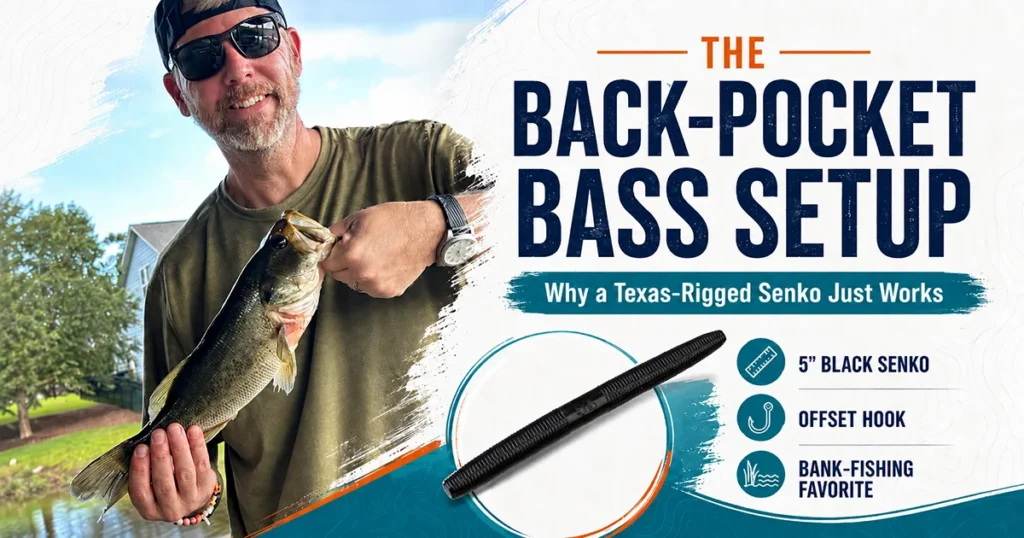
    The Back-Pocket Bass Setup: Why a Texas-Rigged Senko Just Works

    This article may contain affiliate links. As an Amazon Associate, Anglers Insights may earn from qualifying purchases at no additional cost to you.

    There are plenty of bass lures that work. There are also plenty of bass lures that seem to require a second mortgage, a dedicated tackle backpack, three rods, four knot changes, and a YouTube tutorial watched in the parking lot.

    Then there is the Senko.

    More specifically, give me a bag of 5-inch black Yamamoto Senkos, a few offset shank worm hooks, and a pair of pliers, and I’m good. That is not a theory. I have carried that exact setup in my back pocket and wandered the banks of ponds and lakes in North Carolina with no tackle box, no extra gear, and no real plan beyond, “Let’s see who’s home.”

    That is the beauty of this bait. It is simple. It packs light. It fishes slow, fast, shallow, deep-ish, clean, messy, from shore, from a kayak, from a dock, or from that weird little opening in the brush where someone clearly fought for their life to make a casting lane.

    And yes, it catches bass.

    The Back Pocket Bass Setup

    Here is the whole setup:

    • One bag of 5-inch Senkos or stick worms
    • A few offset shank worm hooks
    • A pair of pliers
    • Optional: one extra bag of a different color if you insist on making things complicated

    That’s it.

    No giant tackle box. No tray full of crankbaits. No mystery jigs with skirts that look like they survived a raccoon attack. Just a soft plastic stick bait and a hook.

    For me, the confidence version of this setup is a 5-inch black Senko Texas-rigged weightless on an offset shank hook. Dark colors have always produced well for me, especially black, black-blue, green pumpkin, and other darker natural shades. In stained water, low light, shade lines, or around grass and wood, a dark bait throws a clean silhouette. Bass do not need a full product demo. They need something that looks alive, vulnerable, and easy to eat.

    Why the Senko Works So Well

    A Senko does not look like much in the package. That is part of the magic.

    It is basically a soft, thick stick worm. No paddle tail. No curly tail. No claws. No rattles. No drama.

    But when it falls through the water, it has a subtle shimmy that bass have a very hard time ignoring. It does not crash down like a jig. It does not race back like a spinnerbait. It just eases down through the water column like something that made one bad decision and is now available for lunch.

    That fall is the deal.

    Most bites happen when the bait is falling, sitting, or barely moving. That can be frustrating for anglers who want to constantly reel, twitch, hop, and work the bait like they are trying to start a lawn mower. The Senko asks you to do less.

    Cast it out. Let it fall. Watch your line. Give it a twitch or two. Let it fall again.

    If your line jumps, starts swimming sideways, or suddenly feels heavy, congratulations. You may have been robbed by a bass.

    Why I Like the Offset Shank Hook

    The offset shank hook is one of the reasons this setup is so clean.

    That little bend near the eye of the hook helps hold the nose of the bait in place. Once the Senko is threaded on and turned, the hook sits neatly along the body. Then the point can be lightly buried back into the plastic, which makes the rig mostly weedless.

    That matters when you are bank fishing.

    From shore, you are not always casting into perfect water. You are throwing around grass, sticks, laydowns, shallow weeds, brush piles, dock edges, cypress knees, and whatever else the pond or lake has decided to collect. A Texas-rigged Senko with an offset shank hook comes through that stuff better than most open-hook presentations.

    It also casts well. A 5-inch Senko has enough weight on its own that you usually do not need a sinker. That keeps the action natural and lets the bait fall slowly, which is exactly when it tends to get eaten.

    How to Rig a Senko Texas Style

    This is the simple version.

    1. Push the hook point into the nose of the Senko.
    2. Bring the point out about a quarter inch down the bait.
    3. Slide the bait up the hook shank.
    4. Rotate the bait so the hook point faces the body.
    5. Lay the hook against the bait to see where the point should go back in.
    6. Push the hook point through the body.
    7. Skin-hook or lightly bury the point so it stays weedless.

    The goal is simple: keep the bait straight.

    If it is bent like a banana, fix it. A crooked Senko will twist, roll, and look wrong. A straight Senko falls clean and fishes better.

    For a 5-inch Senko, a 3/0 or 4/0 offset worm hook is usually a good place to start. Some anglers prefer an EWG hook because the wider gap gives the plastic more room to move during the hookset. Others prefer a round bend offset hook because it keeps a slimmer profile and lines up nicely with a stick bait.

    Do not overthink this at first. Get a decent hook, rig it straight, and fish it slowly. That will solve more problems than owning seventeen hook styles you do not trust.

    How to Fish It

    The hardest part of fishing a Senko is not doing too much.

    Here is the basic rhythm:

    • Cast near cover, shade, grass, bank edges, docks, or visible structure.
    • Let the bait fall on semi-slack line.
    • Watch the line closely.
    • Wait longer than you want to.
    • Give it one or two small twitches.
    • Let it fall again.
    • Repeat your way back in.

    The “semi-slack” part matters. If the line is too tight, you can pull the bait unnaturally and kill some of that slow shimmy. If the line is too loose, you may miss the bite entirely. You want enough slack for the bait to fall naturally, but enough awareness to see or feel something change.

    Sometimes the bite feels like a tap.

    Sometimes it feels like dead weight.

    Sometimes your line just starts moving off like it has somewhere better to be.

    When that happens, reel down, get the slack out, and set the hook with purpose. You do not need to swing like you are chopping firewood, but you do need to drive the hook home.

    Where This Setup Shines

    This is a great pond and lake setup because it works in so many common bank-fishing situations.

    Throw it around:

    • Grass lines
    • Small openings in vegetation
    • Laydowns and brush
    • Dock posts
    • Shady banks
    • Drainage pipes
    • Small points
    • Edges where shallow water drops off

    If you are walking the bank, this bait lets you move light and fish efficiently. You can cover water, make a few casts to likely spots, and keep moving until something tells you to slow down.

    That is another reason I like the Texas-rigged version. It gives me a little more casting distance and control than a wacky rig, especially when I am trying to reach a specific pocket, skip near cover, or fish from awkward shoreline angles.

    Texas Rig vs. Wacky Rig

    Let’s be clear: a wacky-rigged Senko flat-out catches fish.

    Anyone who tells you otherwise is either lying, selling something, or has never watched a bass inhale one like it owed money.

    A wacky rig lets both ends of the bait flutter as it falls. It is an incredible presentation when fish are finicky, when you want the bait to stay in one area longer, or when you are fishing more open water with fewer things to snag.

    But for walking banks, fishing around cover, and packing light, I usually lean Texas rig.

    The Texas rig is cleaner through grass and wood. It gives me more control. It casts well. It lets me work the bait through messy little shoreline spots without instantly donating tackle to the pond gods.

    So no, wacky is not wrong. Wacky is deadly.

    I just prefer the Texas rig when I want one simple setup that can handle almost anything I am likely to run into from the bank.

    Why Black Is Always in My Bag

    Fishing colors can get ridiculous fast.

    There are days when the bass want green pumpkin with purple flake, watermelon red, junebug, smoke, baby bass, morning dawn, or some limited-run color named after a breakfast cereal.

    Fine. That stuff can work.

    But if I’m carrying one bag, I want black.

    Black creates a strong silhouette. It shows up in stained water. It still works in clear water. It looks natural enough to pass, but bold enough to be found. It is also easy to trust, and confidence matters more than most anglers want to admit.

    If you want a tiny starter lineup, I would keep it simple:

    • Black for confidence, stained water, shade, and low light
    • Green pumpkin for clearer water and natural forage situations
    • Black-blue for dirty water, vegetation, and cloudy days

    You do not need twenty colors to catch bass. You need one or two colors you believe in and enough patience to fish them well.

    Yamamoto Senkos vs. Other Stick Baits

    The original Yamamoto Senko has a reputation for a reason. It has the fall, the softness, the salt, and that subtle action that made stick baits a permanent part of bass fishing.

    There are plenty of other stick worms that catch fish too. Some are cheaper. Some are more durable. Some last longer after a fish chews on them. That matters because Yamamoto Senkos are not exactly famous for surviving all day. They are soft, salty, and effective, but that also means they can tear up faster than tougher plastics.

    That is the tradeoff.

    Yamamoto Senkos tend to have excellent action and a proven fall. Cheaper alternatives can still catch plenty of fish, and more durable options may save money over time. But if I am building the simplest possible confidence setup, I am starting with the original or something very close to it.

    Once you trust the presentation, experiment from there.

    The One-Bag Challenge

    If you are new to bass fishing, coming back to it, or just tired of hauling too much gear, try this:

    Take one bag of 5-inch black Senkos, a few offset hooks, and pliers. Leave the tackle box at home. Walk the bank for an hour.

    Fish slowly. Cast to obvious targets. Watch your line. Resist the urge to constantly change baits.

    You may be surprised by how freeing it feels.

    There is something refreshing about stripping fishing back down to the basics. No clutter. No second-guessing. No digging through trays while a good-looking piece of water sits unfished in front of you.

    Just a worm, a hook, and the quiet belief that a bass is about to make a bad decision.

    Final Thought

    A Texas-rigged Senko is not the flashiest bass lure. It will not impress the guy with a boat deck that looks like a tackle shop exploded. It will not win any awards for innovation. It barely even looks like it should work.

    But it does.

    It works because it is simple, natural, versatile, and easy to fish from almost anywhere. It is the kind of bait that belongs in every tackle box, every kayak crate, every backpack, and maybe even your back pocket.

    And honestly, if this is already your go-to, you may not need the tackle box at all.