
This article may contain affiliate links. As an Amazon Associate, Anglers Insights may earn from qualifying purchases at no additional cost to you.
There are plenty of bass lures that work. There are also plenty of bass lures that seem to require a second mortgage, a dedicated tackle backpack, three rods, four knot changes, and a YouTube tutorial watched in the parking lot.
Then there is the Senko.
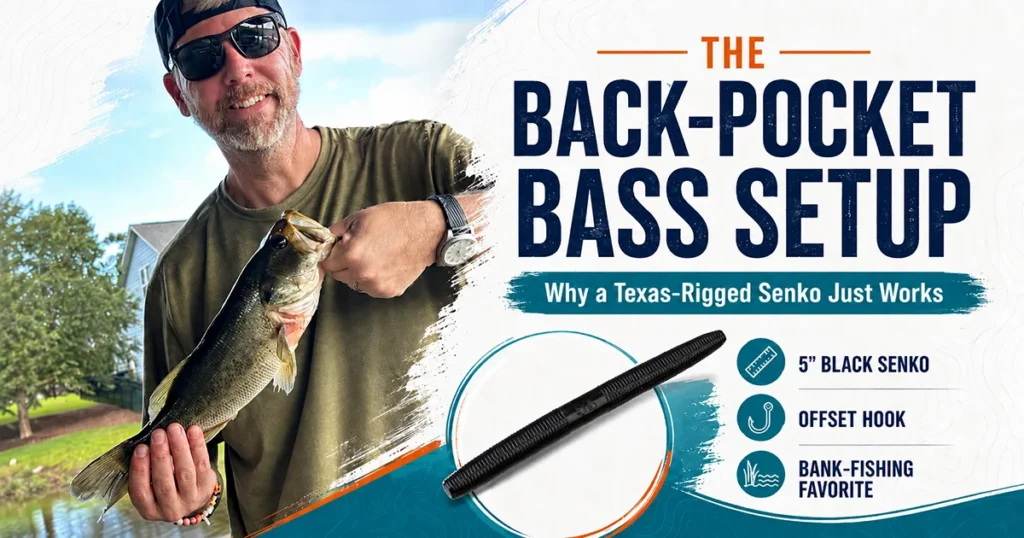
More specifically, give me a bag of 5-inch black Yamamoto Senkos, a few offset shank worm hooks, and a pair of pliers, and I’m good. That is not a theory. I have carried that exact setup in my back pocket and wandered the banks of ponds and lakes in North Carolina with no tackle box, no extra gear, and no real plan beyond, “Let’s see who’s home.”
That is the beauty of this bait. It is simple. It packs light. It fishes slow, fast, shallow, deep-ish, clean, messy, from shore, from a kayak, from a dock, or from that weird little opening in the brush where someone clearly fought for their life to make a casting lane.
And yes, it catches bass.
The Back Pocket Bass Setup
Here is the whole setup:
- One bag of 5-inch Senkos or stick worms
- A few offset shank worm hooks
- A pair of pliers
- Optional: one extra bag of a different color if you insist on making things complicated
That’s it.
No giant tackle box. No tray full of crankbaits. No mystery jigs with skirts that look like they survived a raccoon attack. Just a soft plastic stick bait and a hook.
For me, the confidence version of this setup is a 5-inch black Senko Texas-rigged weightless on an offset shank hook. Dark colors have always produced well for me, especially black, black-blue, green pumpkin, and other darker natural shades. In stained water, low light, shade lines, or around grass and wood, a dark bait throws a clean silhouette. Bass do not need a full product demo. They need something that looks alive, vulnerable, and easy to eat.
Why the Senko Works So Well
A Senko does not look like much in the package. That is part of the magic.
It is basically a soft, thick stick worm. No paddle tail. No curly tail. No claws. No rattles. No drama.
But when it falls through the water, it has a subtle shimmy that bass have a very hard time ignoring. It does not crash down like a jig. It does not race back like a spinnerbait. It just eases down through the water column like something that made one bad decision and is now available for lunch.
That fall is the deal.
Most bites happen when the bait is falling, sitting, or barely moving. That can be frustrating for anglers who want to constantly reel, twitch, hop, and work the bait like they are trying to start a lawn mower. The Senko asks you to do less.
Cast it out. Let it fall. Watch your line. Give it a twitch or two. Let it fall again.
If your line jumps, starts swimming sideways, or suddenly feels heavy, congratulations. You may have been robbed by a bass.
Why I Like the Offset Shank Hook
The offset shank hook is one of the reasons this setup is so clean.
That little bend near the eye of the hook helps hold the nose of the bait in place. Once the Senko is threaded on and turned, the hook sits neatly along the body. Then the point can be lightly buried back into the plastic, which makes the rig mostly weedless.
That matters when you are bank fishing.
From shore, you are not always casting into perfect water. You are throwing around grass, sticks, laydowns, shallow weeds, brush piles, dock edges, cypress knees, and whatever else the pond or lake has decided to collect. A Texas-rigged Senko with an offset shank hook comes through that stuff better than most open-hook presentations.
It also casts well. A 5-inch Senko has enough weight on its own that you usually do not need a sinker. That keeps the action natural and lets the bait fall slowly, which is exactly when it tends to get eaten.
How to Rig a Senko Texas Style
This is the simple version.
- Push the hook point into the nose of the Senko.
- Bring the point out about a quarter inch down the bait.
- Slide the bait up the hook shank.
- Rotate the bait so the hook point faces the body.
- Lay the hook against the bait to see where the point should go back in.
- Push the hook point through the body.
- Skin-hook or lightly bury the point so it stays weedless.
The goal is simple: keep the bait straight.
If it is bent like a banana, fix it. A crooked Senko will twist, roll, and look wrong. A straight Senko falls clean and fishes better.
For a 5-inch Senko, a 3/0 or 4/0 offset worm hook is usually a good place to start. Some anglers prefer an EWG hook because the wider gap gives the plastic more room to move during the hookset. Others prefer a round bend offset hook because it keeps a slimmer profile and lines up nicely with a stick bait.
Do not overthink this at first. Get a decent hook, rig it straight, and fish it slowly. That will solve more problems than owning seventeen hook styles you do not trust.
How to Fish It
The hardest part of fishing a Senko is not doing too much.
Here is the basic rhythm:
- Cast near cover, shade, grass, bank edges, docks, or visible structure.
- Let the bait fall on semi-slack line.
- Watch the line closely.
- Wait longer than you want to.
- Give it one or two small twitches.
- Let it fall again.
- Repeat your way back in.
The “semi-slack” part matters. If the line is too tight, you can pull the bait unnaturally and kill some of that slow shimmy. If the line is too loose, you may miss the bite entirely. You want enough slack for the bait to fall naturally, but enough awareness to see or feel something change.
Sometimes the bite feels like a tap.
Sometimes it feels like dead weight.
Sometimes your line just starts moving off like it has somewhere better to be.
When that happens, reel down, get the slack out, and set the hook with purpose. You do not need to swing like you are chopping firewood, but you do need to drive the hook home.
Where This Setup Shines
This is a great pond and lake setup because it works in so many common bank-fishing situations.
Throw it around:
- Grass lines
- Small openings in vegetation
- Laydowns and brush
- Dock posts
- Shady banks
- Drainage pipes
- Small points
- Edges where shallow water drops off
If you are walking the bank, this bait lets you move light and fish efficiently. You can cover water, make a few casts to likely spots, and keep moving until something tells you to slow down.
That is another reason I like the Texas-rigged version. It gives me a little more casting distance and control than a wacky rig, especially when I am trying to reach a specific pocket, skip near cover, or fish from awkward shoreline angles.
Texas Rig vs. Wacky Rig
Let’s be clear: a wacky-rigged Senko flat-out catches fish.
Anyone who tells you otherwise is either lying, selling something, or has never watched a bass inhale one like it owed money.
A wacky rig lets both ends of the bait flutter as it falls. It is an incredible presentation when fish are finicky, when you want the bait to stay in one area longer, or when you are fishing more open water with fewer things to snag.
But for walking banks, fishing around cover, and packing light, I usually lean Texas rig.
The Texas rig is cleaner through grass and wood. It gives me more control. It casts well. It lets me work the bait through messy little shoreline spots without instantly donating tackle to the pond gods.
So no, wacky is not wrong. Wacky is deadly.
I just prefer the Texas rig when I want one simple setup that can handle almost anything I am likely to run into from the bank.
Why Black Is Always in My Bag
Fishing colors can get ridiculous fast.
There are days when the bass want green pumpkin with purple flake, watermelon red, junebug, smoke, baby bass, morning dawn, or some limited-run color named after a breakfast cereal.
Fine. That stuff can work.
But if I’m carrying one bag, I want black.
Black creates a strong silhouette. It shows up in stained water. It still works in clear water. It looks natural enough to pass, but bold enough to be found. It is also easy to trust, and confidence matters more than most anglers want to admit.
If you want a tiny starter lineup, I would keep it simple:
- Black for confidence, stained water, shade, and low light
- Green pumpkin for clearer water and natural forage situations
- Black-blue for dirty water, vegetation, and cloudy days
You do not need twenty colors to catch bass. You need one or two colors you believe in and enough patience to fish them well.
Yamamoto Senkos vs. Other Stick Baits
The original Yamamoto Senko has a reputation for a reason. It has the fall, the softness, the salt, and that subtle action that made stick baits a permanent part of bass fishing.
There are plenty of other stick worms that catch fish too. Some are cheaper. Some are more durable. Some last longer after a fish chews on them. That matters because Yamamoto Senkos are not exactly famous for surviving all day. They are soft, salty, and effective, but that also means they can tear up faster than tougher plastics.
That is the tradeoff.
Yamamoto Senkos tend to have excellent action and a proven fall. Cheaper alternatives can still catch plenty of fish, and more durable options may save money over time. But if I am building the simplest possible confidence setup, I am starting with the original or something very close to it.
Once you trust the presentation, experiment from there.
The One-Bag Challenge
If you are new to bass fishing, coming back to it, or just tired of hauling too much gear, try this:
Take one bag of 5-inch black Senkos, a few offset hooks, and pliers. Leave the tackle box at home. Walk the bank for an hour.
Fish slowly. Cast to obvious targets. Watch your line. Resist the urge to constantly change baits.
You may be surprised by how freeing it feels.
There is something refreshing about stripping fishing back down to the basics. No clutter. No second-guessing. No digging through trays while a good-looking piece of water sits unfished in front of you.
Just a worm, a hook, and the quiet belief that a bass is about to make a bad decision.
Final Thought
A Texas-rigged Senko is not the flashiest bass lure. It will not impress the guy with a boat deck that looks like a tackle shop exploded. It will not win any awards for innovation. It barely even looks like it should work.
But it does.
It works because it is simple, natural, versatile, and easy to fish from almost anywhere. It is the kind of bait that belongs in every tackle box, every kayak crate, every backpack, and maybe even your back pocket.
And honestly, if this is already your go-to, you may not need the tackle box at all.
Leave a Reply